
If your cat is showing signs of pregnancy, or you suspect she may have become pregnant during mating season, the first step is to take her to the vet.
In this article, we share the best tips and practices for handling this innocent request…
It’s hard to confirm a pregnancy until a cat is around three to four weeks along.
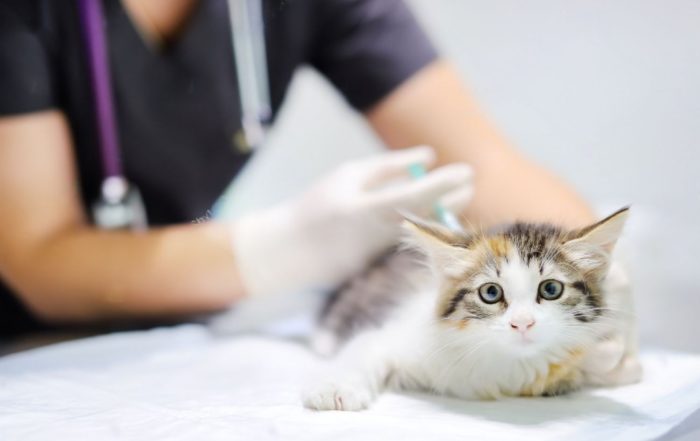
Even so, if your cat seems unwell or shows unusual signs, you should still take her to the vet for a check-up — and be sure to tell the vet she might be pregnant.
Veterinary Care for a Pregnant Cat
At around three weeks, your vet may be able to confirm the pregnancy by gently feeling your cat’s belly, although this can be harder if the cat is overweight or because of other factors such as stool or a full bladder.
Where available, an ultrasound can confirm or rule out pregnancy.
During this early-to-mid stage, your vet may still discuss the option of spaying your cat and ending the pregnancy, which you may choose for your cat’s health or to help reduce cat overpopulation.
But if you’ve decided to let your cat have her kittens — and enjoy seeing those tiny bright eyes open to the world and hearing their sweet little meows — your vet can advise you on caring for your pregnant cat and on the care the kittens will need after birth.
This is also a good time to start thinking about how to find good homes for the kittens on the way.
At around 55 days, your vet may recommend an X-ray to see how many kittens to expect.
Knowing how many kittens she’s carrying will help you tell more accurately when the birth is complete.
Feeding a Pregnant Cat
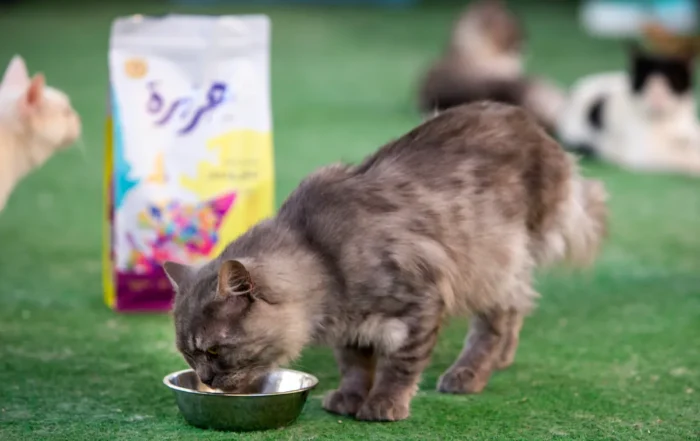
Feed your pregnant cat a high-quality food designed for growth. Look for a nutritional adequacy statement showing the food is complete and balanced for growth and reproduction.
Wet food can be a healthier choice than dry food, but both play an important role for a pregnant cat.
When choosing food, it’s always best to ask your vet what they recommend.
Be careful not to overfeed her in the early weeks. She needs plenty of good nutrition for herself and her kittens, but not too much — becoming overweight can cause problems for her and the kittens.
Make sure her food provides the extra calories and nutrients she needs, and don’t increase the amount unless she’s underweight or acting hungry.
Monitor her body condition throughout the pregnancy with your vet’s help.
From about six weeks into the pregnancy, she should eat small, frequent meals.
The pressure of the kittens on her stomach makes it hard to eat much at once, yet she needs extra food — so split her meals into four to six servings a day.